Showing posts with label Small Business. Show all posts

Wednesday, March 2, 2016

Are you a non-employer business owner?

Can a business owner have a business with no employees?


When looking at the organization of other people's businesses, I sometimes think that many think the answer to the question is, "no". The businesses we hear about on the news and in social media are those that have a few employees with the profit to sustain that kind of business structure. 

Do you realize that 23 million U.S. business owners have a business structure that includes no employees?  

The U.S. Census Bureau calls these types of businesses "non-employer businesses". I am a non-employer business and in some ways therm makes me think my  business isn't as important or needed as an "employer business". Maybe it is the use of the prefix "non" in the title. Whatever the reason, I need to remind myself, as you need to remind yourself, that this feeling or opinion is not accurate. A non-employer business is just as relevant and important as other businesses. 

About 24% of the non-employer businesses in the United States make $40,000 per year. That is also the median wage for most U.S. wage earners. I don't think that this is a coincidence. If you are one of those businesses, that makes enough money to sustain itself, then I would think that you are well on your way to being a great success. 

What does a business have to do to get to the next level; to get to be an employer business? Here are a few tips:

1. Have a plan.  You need to get your business organized. If you haven't carved out a plan for your business, then get started now. Develop a plan to structure your business in such a way that growth naturally comes from the work you do. Include marketing needs in the plan. 

The plan should also include how to deal with taxes. Don't allow your business to just exist. Let it work for you; take advantage of the tax breaks that a growing business can provide.

2. Take your business seriously.  In order to grow from a non-employer business to an employer business, you must take yourself and your business seriously. That means working the hours that need to be worked. Granted, it is nice to get up and walk to your office at the end of the hall without having to change clothes, but are you really taking yourself seriously when you do that? Do you take impromptu vacations or binge watch TV when you could  be working? 

Set up regular work hours. Get up, get showered, get dressed and walk into your home office just as you would a traditional office. When you take yourself seriously, everyone else around you will, too.

3. Call yourself what you are.  I've had some people actually say that I'm not really a freelance writer because I didn't make more than a $1,000 last month. Don't listen to the naysayers. Define yourself. If you are a business owner in a certain niche, then call yourself what you are. Be confident in your skills, tell those around you what you do, offer to help others get to their next level. 

4. Network. Who says you have to wait until you are making $50,000 a year before you choose to network with other people working the same business you are. Get out there and meet some other non-employer business owners!  The most efficient way to increase your knowledge is to learn from others; from both their mistakes and their successes. 

Whatever you do as your business, remember that you are only limited by your imagination. If you have a seed of imagination in your business idea, you are poised for success. 

Now get out there and be the best non-employer business you can be!

Wednesday, February 24, 2016

Tax Deductions that many small businesses don't think about

If you are like most people, you've just went through one of the most dreaded times of the year - tax filing. With that pain in mind, this is the best time to talk about what deductions you may or may not have missed.

Most people seem to think that a business isn't really a business until you have an employee. That those at-home party businesses like Pampered Chef or Mary Kay aren't businesses that need to be tracking expenses and creating deductions at tax time. That thought process couldn't be farther from the truth. From the day you decide to become a business owner - no matter the size of your business - you should be tracking expenses and keeping receipts.

Here are few examples of deductions that many sole proprietors do not realize they should be taking advantage of.

Not Paying Quarterly Taxes - Every business will need to pay taxes. The question becomes, do you pay the taxes on your own, in your tax filing, or do you them quarterly? The answer depends on how much profit your business is making and the requirements of your state.

For many small businesses, quarterly tax payments are a requirement. If not made on time the business will incur fines until the taxes are paid. The quickest way to find out if your business is required to file taxes, please visit the Self-Employed Individuals Tax Center. Your financial adviser can best advise you on the state requirements for tax filing.

So, if your business isn't one of those required to file quarterly tax payments no need to worry about the subject, right? Not so fast. You should at least look at your businesses quarterly profit and loss statement and decide if a portion of the sales should be set aside to help pay any tax payments needed at the end of the year based on your additional income.  Again, your financial adviser will be able to help you calculate how much you should set aside.

Under Reporting Your Business Income - Every client that you have that has paid you at least $600 in one calendar year is required to send your business a 1099-MISC stating your compensation. The IRS will be in receipt of a duplicate copy of that form. You guessed it, there is no way of getting out of reporting the income. Even if your client does not send you the 1099 form, you are still required to to add the income to your bottom line.

The IRS may not realize the mistake this year, but they will find it eventually and come a calling. Don't waste your time, or money in penalties, just report the actual income your business received.

Home Office  Deduction - Many business owners are scared of this deduction because it seems confusing and may increase the chance of an audit. The important fact to remember is that if you have a dedicated office in your home, you may use this deduction. Do you only use part of a room for an office? This deduction may still be for you. The important fact to remember is that the room or area must be exclusively used for your business.

In 2013, the IRS introduced a simplified method of figuring this deduction. Take the square footage of the room or area devoted to your business and multiply by $5. The deduction using the simplified method is capped at $1,500 per year.

For many business owners, it may be more advantageous to use the actual expense of the room. This is where your tax adviser may be the most helpful. Run the numbers past him or her and decide how best to proceed; just make sure to not leave the deduction on the table.

Over Deducting Your Gifts - For some business owners the heading should be - over gifting your clients is a waste of money. First, let's discuss what "gifts" mean. In this context they could be anything from holiday presents to small tokens of appreciation for their business. Remember, the gift must be relevant to the success of your business and the relative relationship with the client.

So, how extravagant should you be with those gifts? IRS allows a business to deduct only the first $25 of gift cost per recipient. So, whether you spend $100 on one gift or on multiple gifts, only $25 is deductible. I'm pretty sure you know how much I would spend on each client. Make sure you keep all receipts for the gifts that you purchase, because the IRS will ask for receipts. That also means you should never over-inflate the gift deduction; a $2,000 deduction means you spent $25 on 80 clients. If that isn't true, don't report it.

Difference Between Equipment and Supplies - The IRS treats equipment and supplies differently. Let's take care of the definitions first.
Supplies = Items that get used during the year. Examples are printer ink, paper, envelopes, etc.
Equipment = Typically higher value items that last longer than a year. Examples are computers, software, business furniture, etc.
The cost of supplies will be reported on Schedule C; whereas, equipment costs will be reported on Form 4562. It isn't a good idea to mix them up because there are limits for many items and the deduction may be denied if not applied correctly.. Additionally, equipment can be written off through a full deduction (depending on the cap) or depreciated each year. Your financial adviser will be able to steer you in the right direction.

Not Reporting All Your Expenses - When asked which business expenses constituted tax deductions, most people answered  correctly with  computer equipment, mobile phone plan, health insurance premiums, and travel. However, many business owners, especially the sole proprietor, didn't realize that books, online courses, mileage to meet with clients, Web hosting, and stamps can also be deducted as expenses.

The best idea is to track all expenses that your business incurs. Then at the end of the year, go over those expenses with your financial adviser to best determine which can or cannot be taken as deduction. Your organizational efforts will not go to waste. Whatever cannot be deducted, can certainly be entered into your annual budget for next year to better determine your business goals.

Choosing the Wrong Legal Identity - Unfortunately, many sole proprietors do not realize that the legal identity of their business can positively or negatively affect the amount of taxes due to Uncle Sam. Sometimes legally establishing a C Corporation, S Corporation, or LLC that's taxed like an S Corp may help lower the tax bill.

A discussion with your tax adviser may clear up any confusion and set you down a clear path for success. You can even do your own research be looking at the information available on IRS' Self-Employed Individual Tax Center website.

As you can see, there are many ways those who have a very small business can still take advantage of tax deductions. With a little organization, advice from your financial and tax advisers, and some persistence you can be better prepared when tax time comes around next year.


Tuesday, February 16, 2016

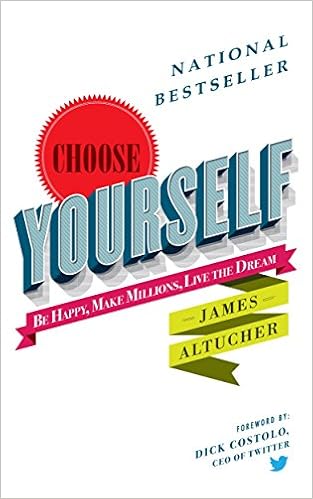
Book Review - "Choose Yourself"


A couple of months ago, I started reading a book that I believe changed my life. Because of it, I chose to reinvent myself.

For the last several years I have been writing for print and online publications and various people in my network. I wanted to make money at it, but it just didn't materialize into what I had hoped. We made the decision to move across the country and that was the end of my writing career.

After we moved to California it became clear that a part-time job was needed. I struggled to find something that I could do from home that would make money. My sewing hobby wasn't going it, I love kids but I had no desire to take care of someone else's child, and I had struck out the idea of working a part-time job outside my home. I wondered if my writing ability could be that job I needed. The only problem - I had no idea how to start a business in an area where I had no network.

We had decided to take a long road trip - get out of the house and do something fun. In getting ready, started to search through the book offerings on Amazon. I came upon a book that had an interesting title - Choose Yourself - Be Happy, Make Millions, Live the Dream. I'm pretty skeptical, so the title seemed a little over the top. But, I thought what the heck it was only $.99. So, I downloaded it along with a couple of other books - just in case I didn't like this one.

Well low and behold, I was blown away by the book.


Who is James Altucher

Besides being an author that has a very easy-to-read writing style, James Altucher practices what he preaches. Altucher explains how he has built up million dollar companies only to loose them to a bad economy also some mistakes of his own.  He does such a great job of explaining how he was feeling during his lowest moments and how he got out of each of them. I could totally relate to what he was writing.

Humor is another needed skill that Altucher has in his arsenal. Choose Yourself could be a very intense book if it didn't have humor. The lightness of the writing often makes the subject matter more understandable and less burdensome.

Today, Altucher is a successful entrepreneur, author, and pod-caster. I'm sure he has a few more successful titles in there somewhere, but for now that is a good start. He is someone who has developed a strategy for picking up your life and making it what you want it to be.

The Daily Practice

Very simply put, a daily practice is something you do on a daily basis. It is meant to be a practice that invigorates your entire being - the physical, emotional, mental, and spiritual parts of your being. In his book, Altucher lists several things that one can do for a daily ritual. The items range from sleep eight hours to write down a list of ideas to surprising someone. Once again, the idea is that the daily practice will put you into a place where each part of your body - physical, emotional, mental, and spiritual - is aligned.

The daily practice is very similar to Reggie Rivers idea of not focusing on the goal, but focus on behaviors to reach the goal. Similarly, the daily practice focuses on behaviors that need to change or need to be developed to get one to the next level. Starting very small, do only one thing from the list and do it consistently every day. Then build on that item and incorporate two items and then three items and so on until you have a daily practice of items that feed your entire body - physical, emotional, mental, and spiritual.

For me, I picked four items for my daily ritual:

  • Thankful journal - I bought an inexpensive journal from the Dollar Tree - yep, it cost me a whole dollar. I got a pen out of the junk drawer in the kitchen and put both the journal and the pen next to my bathroom sink. Every morning, I make a point of writing down ten things I'm thankful for. This one item has completely changed my perspective. It has opened up my mind in the morning to the possibilities of today. Even if I wake up in a bad mood, after writing out the ten things I'm thankful for I have no choice but to change my mood.
  • Exercise - This is one of the items that changes a bit for the weekend. I confess that I sleep in on the weekends and only do the exercise in the morning during the week. That means I have to make up the exercise at different times on both Saturday and Sunday. During the weekday mornings, this isn't that long of a session; a 15-minute walk with our dogs. It is just enough to get me up and moving and ready to sit at my computer for the next part of my daily ritual.
  • Daily Devotion - Every day, I choose to open up my Bible and read a few verses and then I write a small post on Facebook describing what the passage said to me. I've found that if I do this the first thing in the morning it centers my day, it puts me in the right frame of mind to deal with the issues at work, and it puts me in connection with my creator. Plus, it gets me writing in the morning.
  • Writing - Every morning, after my thankful journal, exercise, and daily devotion I do some writing. It isn't much, but it is something. Sometimes it is writing for me, sometimes it is writing for a client; whoever it is for, I write. 
I have found that doing this daily ritual for the last two months has made me a better human being, a better writer, and a better wife.

Choose Yourself and Small Business

Some of you may be asking what this has to do with small business Wednesday. The answer is - everything. This book put into perspective that if I wanted to make my writing into a business I needed to think outside the box and push some envelopes. I put my name out on a few freelancing websites, started my blog, got my Twitter feed going, and sent out a few advertising e-mails. Within a week, I had my first two clients. This week I have three clients. My goal is that within two years, I will not be working for someone else. 

I realized through this book that my writing is my small business. I needed the  put it into perspective. I don't have to have employees to have a small business, I don't have to be making $1,000 a month, and I certainly didn't have to live up to someone else's expectations. I needed to choose myself. I needed to reinvent myself. I needed to take myself and my writing seriously. 

My suggestion is for you to pick up the book, give it a read, start a daily ritual, and let your mind, body, and spirit take you to whatever level you feel your business should be at.

Today - Choose Yourself!


Wednesday, February 3, 2016

3 Reasons Your Business Should have a Blog

Small business owners usually have two reactions to blogging; they do not see the need and they are too busy.  I would counter that in today's world of competition, tight budgets (both business and personal), and open world markets a blog is a needed part of any business plan.

If you remember my previous post on creating a business plan, one of the uses for a well written plan guiding the business in growth activities. Blogging is one of those activities. It should have been part of your marketing plan. 

If it was not, here are three reasons you should reconsider using a blog to grow business

1. Increase customer trust and loyalty by blogging. 

Customers want to have faith that they can call you an expert in your field. Blogging about your business, services or products offered, and overall market condition puts you, the business owner, in the seat of the expert. Your current customers will be able to gain a better understanding of the market you are in, a better understanding of the values of your business, and a better understanding of you, the business owner.

When customers have confidence in your expertise they will be more loyal to call on your business when needed. The same can be said for those potential customers looking for a new service or product supplier. A blog allows you to showcase what your business brings to the table. This is an extension of your marketing plan; the place where you not only showcase your business, but also a place where you can develop a relationship with potential customers so that your business name pops up in their mind when they have a problem.

Your blog posts do not always have to be the written word. If you do better at speaking to a crowd than writing to a crowd, how-to videos or product videos are worth a try. This is the place for your business to shine, to stick out more than the competition. Do you have a common problem that customers should be able to fix at home, and it doesn't really provide you with a lot of profit? Make some how-to videos or posts about this process, show them how to solve their own problem and save your services for those that are profit generating and more helpful to the customer.

2. Increase web traffic to your site.  

We all know that having a website does not guarantee new customers. Add a page to your current website and house your blog there. Not only will you be able to build a relationship with your current customers, but potential customers will be brought up to speed on your expertise, other services and products your business offers.  

Take advantage of SEO to drive website views. A website is static. It doesn't change very often, if at all. The blog page, on the other hand will change on a regular basis. Maybe your business can have Monday tips, Wednesday deals, and  Friday fun day where you blog about something other than your business or services.

The idea is to bring current and potential customers to you. Make the blogging experience informational and fun. Gain traffic to your website and in turn increase your sales.


3. Blogging is a great way to network with others in your industry. 

Your blog will not only be read by your customer, but other small businesses in your industry will be reading it to. Every small business owner knows that being in a network of other business professionals  is a must. Use the internet to your advantage - allow others to connect with you.

Some of your posts can be showcasing other business owners in your city, in different industries, or even in other parts of the country. Your blog can be a way to share business ideas with other owners; using the comments section may be a great way to even solve some of your own business issues. How would you do this? Write a blog about a problem that you are trying to conquer, ask other's to put their suggestions in the comments section. You may even be able to use some of those comments for future blog posts. 

The point of blogging is not so much to add another activity to your day. The point of blogging is to connect with others including potential customers, current customers, and other business owners. This wide connection will increase website visits and ultimately sales.

Not sure where to start with blogging? I can help. Simply click on the Contact Me page and send me your information. There are several packages you can choose from, including one where I simply write the blog post, e-mail it to you, and you have the ability to post it when you wish. 

Don't allow excuses to hinder your business growth. Either start your blog today or call me today so that I can assist in getting your blog started. Today is the day to start.